Productions
Reading Series
NPF Production Guidelines
Production Deadlines
Updated 2/15/2026
DATE | DUE |
March 9 |
|
March 13 |
|
March 27 |
|
March 30 |
|
April 6 |
|
April 10 |
|
April 13 |
|
April 17 |
|
April 20 |
|
April 21 |
|
April 24 |
|
April 27 |
|
April 28 |
|
April 30 |
|
May 2 |
|
Arrangements must be made for return of show items by 48 hours (2 working days) following close. | |
|
|
Festival Calendar
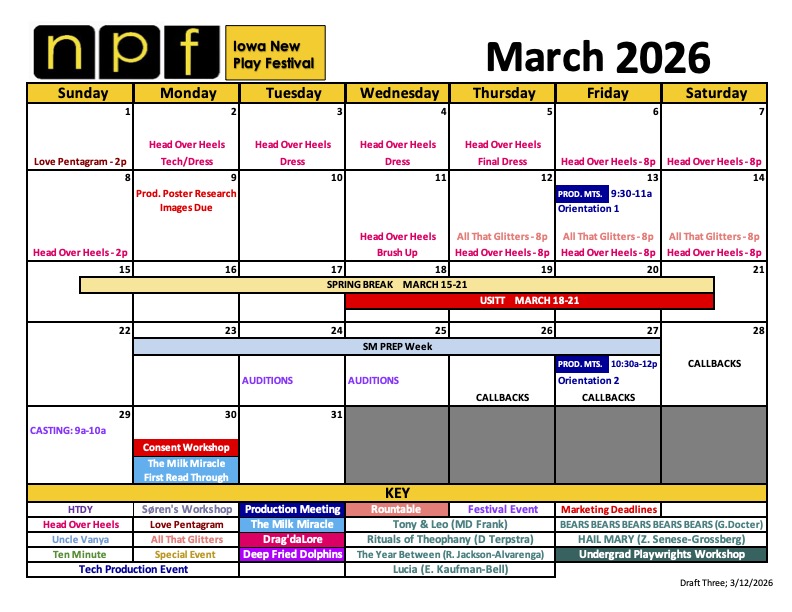
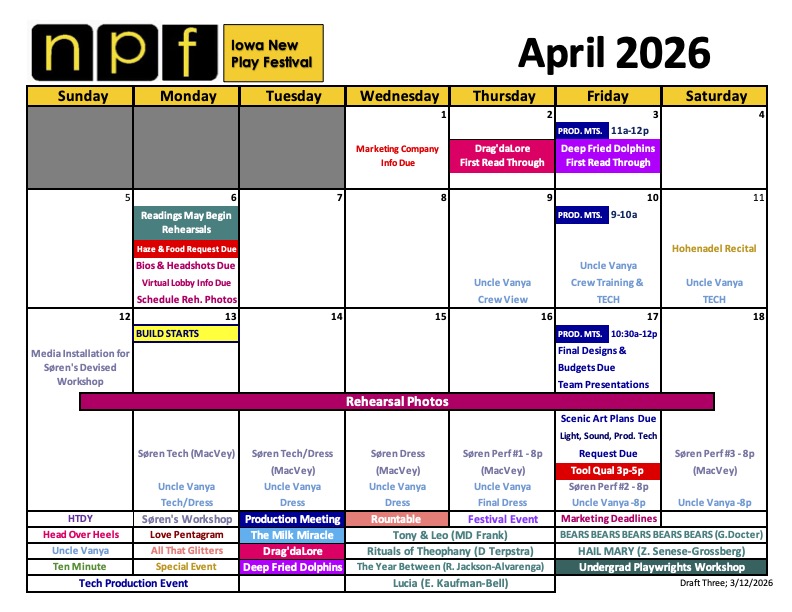
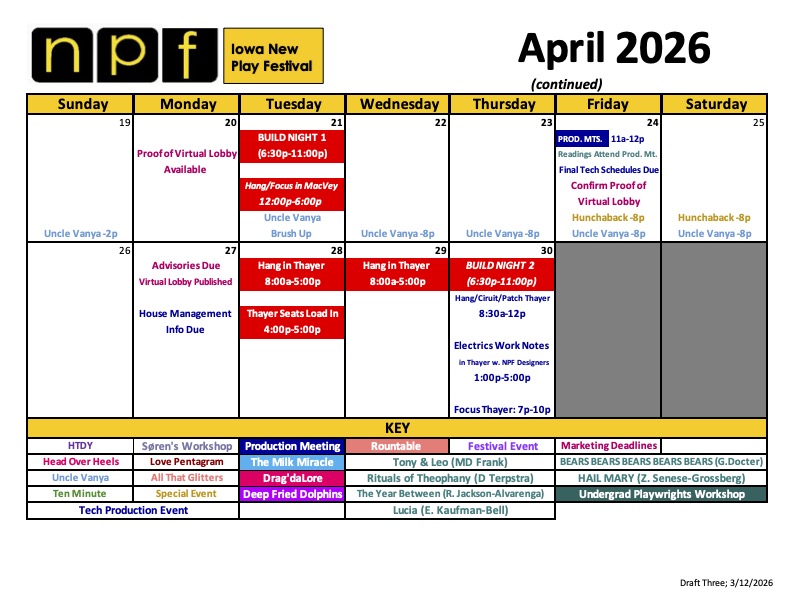
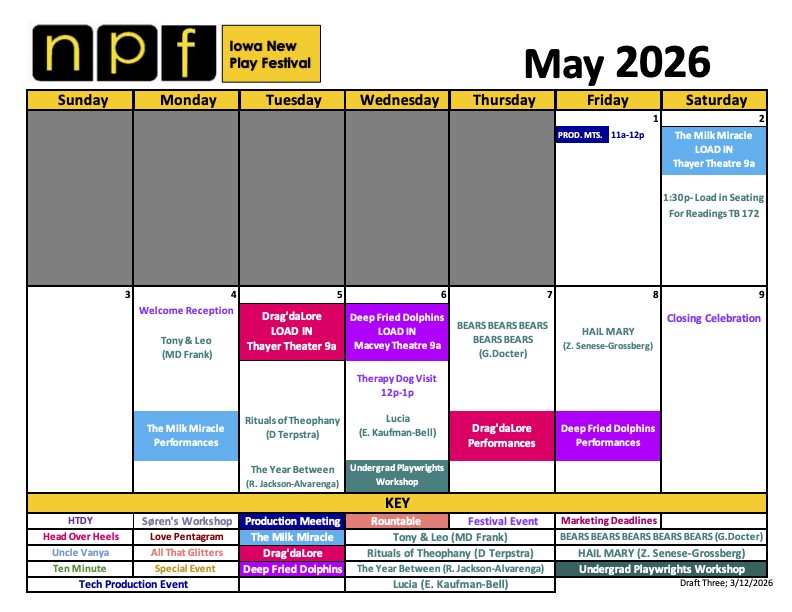
Guidelines
Guidelines for Iowa New Play Festival 2026
The Director of Theatre, Production Stage Management and Production Management reserve the right to amend the New Play Festival Guidelines as it sees necessary for the overall success and well-being of the New Play Festival. In the event that an amendment is made, the Festival PSM will e-mail the change to all Festival personnel and announce it at the next weekly production meeting.
- Click Here for a PDF copy of the NPF 2026 Guidelines.
Safety Consideration,Training, Tool Qualification, Emergency Procedures
Updated 2/15/2026
SAFETY CONSIDERATION
- In all our work SAFETY IS A PRIORITY AT ALL TIMES. Your production must be scheduled and executed with due care for the well-being of all persons working and observing the work (or, indeed, just walking by) and of our theatre building and its equipment. Theatre work of ALL kinds is hazardous and those who practice it often have the lives of their fellow workers and audience members in their hands.
- It is a policy of the department of theatre arts that: In the interest of the highest possible standards of safety in our shops and on our stages, any report of unsafe equipment, facilities, or practices shall be welcomed as a sign of conscientiousness and professional competence.
- All students using departmental facilities and resources are expected to work in a safe and responsible manner. Report any unsafe elements or practices to the Production Stage Manager or to the appropriate shop. If any production staff member views any aspect of a production as unsafe, such as equipment or action, it must be immediately remedied or eliminated.
- In case of an emergency, accident, or any instance in which there is blood exposure, Campus Safety should be contacted by dialing 911. Because of liability issues, students who administer medical care do so at their own risk. Students should also make appropriate efforts to notify their supervisor and if an incident occurs in rehearsal, note it in the report. All accidents should be reported by completing this form from UI Risk Management and sending it to the Scheduling and Facilities Manager, Katie McClellen.
- The Department strongly recommends that students obtain personal health insurance.
TRAINING
Any student participating in the execution of a design or construction of a production on site in the Department of Theatre Arts Scene Shop, Paint Shop, Electrics, or Costume Shop is required to complete training to comply with the safety rules and regulations created by The University of Iowa.
All students must complete the following requirements:
- Complete the online courses required for the Department in which you will be working. To find out which courses you need to take and directions on how to access the training modules, please see the Tool Qualification section on the Theatre Online Callboard. These online courses are considered a “lifetime membership” and only need to be completed once.
Attend and complete the on-site Tool Qualification session at least once every academic year. Dates are determined at the top of each semester. Questions about training can be directed to the Department Production Stage Manager, Samantha Goblirsch-Paradis, NPF Production Stage Manager, Maggie McClellan, or any Shop Supervisor. The Tool Qualification Session for NPF 2026 is scheduled for April 17th from 3:00p-5:00p in the Scene Shop, TB 182.
INTIMACY CONCENT WORKSHOP: Any actor cast in a production and team member who will regularly be in the rehearsal room (director, stage manager, etc.) is required to attend the Consent Workshop held on Monday, March 30th. The PSM will announce the time and location of the training at auditions. Only one Consent is required each academic year. Those who participate in the fall semester are not required to attend the Spring/NPF Consent Workshop. The hour from this workshop will come out of the total weekly rehearsal hours for each show.
EMERGENCY PROCEDURES
Memorize (or add to your contacts) the phone number for the University Campus Safety: 319-335-5022 and the universal emergency number 911. The Department strongly recommends that the Team Leader discuss the division of responsibilities for emergencies with the production staff in advance.
MEDICAL: The role of production staff in most medical emergencies is as a facilitator, not as someone qualified to give any medical assistance. In the event of a medical emergency or accident, call (or have someone call) 911.
FIRE: The Theatre Building is equipped with a fire alarm and a sprinkler system. If the alarm sounds, you must evacuate the building immediately. Campus Safety will automatically call the Fire Department. The House Manager’s main responsibility is to assist with evacuating the audience from the theatre and from the building. Evacuation of dressing rooms and backstage personnel is performed by the production staff. If time and safety permit after evacuating the audience, check through the remainder of the building to evacuate other people who may be rehearsing or meeting.
POWER FAILURE: The theatres are equipped with emergency lighting, which should come on in the event of a power failure. It is advisable for someone to call Campus Safety about the situation. During Performances – Audience stays in their seats, crew will assist actors offstage. Check in with Stage Management & House Management for next steps.
- HIGH WINDS OR TORNADO: In most situations involving high winds or tornado, the safest course is to go to the basement. If during a production, Mabie Cast & Crew gather in large dressing room. MacVey and Thayer Cast & Crew gather in TB 41. All others in the building should shelter in the halls. Monitor local media, NOAA weather radio, etc. The lobby is one of the most hazardous places in the building.
Production Meetings
Updated 2/15/2026
PRODUCTION MEETINGS
There are two orientation production meetings scheduled Friday, March 13th and March 27th. Teams, including directors, playwrights, team leaders, dramaturgs, stage managers, and designers, for all productions and readings are required to attend these meetings.
General production meetings will begin Friday, April 3rd. The Director, Playwright, Dramaturg, and Stage Manager of each production are required to attend all Festival production meetings.
Each production is expected to have a separate weekly artistic/production meeting to discuss issues that do not need to be reported in the general meeting. The time before the general meetings is reserved for this purpose. Production teams should invite their faculty advisor(s) to attend those weekly meetings.
It is advised that each pair of productions presenting in the same theater meet to discuss shared materials as well as load-in and strike plans.
Repeated failure to attend the meetings and breaking rules may result in penalty. These guidelines are intended to ensure safety, equity, and quality participation. If you have any questions, please contact Maggie McClellan, Festival PSM, or the head of the department in question.
Auditions & Casting
Updated 2/15/2026
AUDITIONS
Casting Policy: Auditions for the UI Department of Theatre Arts productions are open to everyone. For academic considerations, priority is given to theatre majors first, and then all other University of Iowa students. Members of the greater Iowa City community are also strongly encouraged to audition.
Prior to auditions, the Production Stage Manager, in consultation with the Director of Theatre, and the Production Director, will post a comprehensive list of dates affecting the productions that are casting. The dates include first rehearsals, technical rehearsals, dress rehearsals, performances and closing dates. The list will also draw attention to dates that may coincide with days of religious commemoration and University holidays. It is the actor's responsibility to check their schedule before auditions and note all conflicts in the conflict survey. The production's rehearsal and performance schedule will take all bona-fide conflicts into account. In agreeing to accept a role, the actor agrees to the rehearsal, tech, and performance schedule. In casting the actor, the Director and Playwright agree to all conflicts listed in the conflict survey.
Audition Sign Up Sheet: The Audition Sign Up Sheet will open by 9:00am on Wednesday March 11th. Traditionally there are 14 actor slots per half-hour session in the general auditions. Actors will be paired by the stage management team and assigned a side from those submitted by the productions.
Show Title: Submit your show's current title to the NPF Production Stage Manager by 5 pm on Wednesday, March 4th. On this date, audition information will begin being published and uploaded to the Performer Bank and the Online Callboard.
Perusal Script: Submit a copy of the most recent script that can be made available in the main office for actors to peruse prior to and during auditions.
Callback Information: Only productions will be allowed to hold callbacks. Each production is allowed four hours of callbacks. You may split your time into separate blocks. Submit your callback preferences by 5 pm on Wednesday, March 4th. Callback slots will be assigned by the end of General Auditions.
First choice of Day and Time
Second choice of Day and Time
Third choice of Day and Time
Callbacks must be scheduled and planned accordingly. Actors cannot be called for an entire callback session unless it’s been pre-arranged (i.e. before auditions) and approved by the Director of Theatre and Department Production Stage Manager. It’s best to limit the time each actor attends a callback to an hour or two at most. Group callbacks are acceptable but must be limited to an hour for each group. It’s best to limit group callbacks to 6-8 actors per group.
Show Information Page: A link will be shared to a template for each team leader to fill out the show information. This will be due by 5 pm on Wednesday, March 4th. Show information will include artistic team, calendar information, roles with descriptions, synopsis of the show, content warnings, intimacy and fight/stunt breakdowns.
Sides: Each show (Productions and Readings) must provide one side that will be used in auditions. Please select this side by Friday, March 13th at 5:00pm. It must have two characters and read at no more than two minutes (a page or less). It is important that we follow this guide so that all sides can be used during the auditions. Shows are encouraged to collaborate on the side selection as variety is helpful during auditions. Please strive for a mixture of gender expression in the sides. Stage management will assign the sides during auditions. Sides should be submitted as a PDF and include information about the characters and who can be assigned to read the role for auditions.
You may only callback actors who participate in the New Play Festival Auditions.
New Play Festival Audition Deadlines:
Wednesday, March 4th by 5:00pm:
Confirm Show Title
Email copy of script for perusal.
Announcement for Non-College Aged Actors
E-mail your callback day/time preferences (Productions Only).
Show information page complete in OneDrive (shared by the Production Stage Manager)
Readings: Who is directing your piece or if you are still in need of a director.
Friday, March 13th by 5:00pm:
Sides due to OneDrive (shared by the Production Stage Manager)
Names of team members who will be attending auditions
Audition Schedule:
Tuesday, March 24th
Auditions Meeting, 6:15pm – 6:30pm
If you miss this meeting due to lateness, you must check in at the SM table before entering the room.
General Auditions, 6:30pm – 11:00pm
Wednesday, March 25th
Auditions Meeting, 6:15pm – 6:30pm
If you miss this meeting due to lateness, you must check in at the SM table before entering the room.
General Auditions, 6:30pm – 11:00pm
Callbacks Schedule:
Thursday, March 26th: (This is a quick turnaround. The callback list will need to be posted by 8:00am on Thursday)
6:30pm – 8:30pm:
Friday, March 27th: (The callback list will need to be posted by 8:00am on Friday)
6:30pm – 10:30pm:
Saturday, March 28th: (The callback list will need to be posted by 8:00am on Friday)
11:00am – 3:00pm:
2:00pm – 4:00pm:
CASTING
Casting Meeting: Sunday, March 29 9am - 11am via Zoom
Casting Policy: Auditions for the UI Department of Theatre Arts productions are open to everyone. For academic considerations, priority is given to theatre majors first, and then all other University of Iowa students. Members of the greater Iowa City community are also strongly encouraged to audition.
Casting Guidelines are based on several principles. (1) The Department encourages the casting of as many actors as possible, especially new actors. (2) We seek to conserve students’ resources by examining quality and size of role rather than quantity. (3) We seek to encourage students to learn how to manage their time and abilities.
- "Non-traditional" casting is the norm for all directors in all productions, except those in which race, gender, disability, or age is the explicit issue. Casting is "non-traditional" when all roles in a script are open to casting without bias in terms of race, gender, disability, or age, so long as the actor can fulfill the artistic requirements of the role. The director of each production has full authority over, and responsibility for, casting. The only exceptions occur:
- When casting would conflict with another production's performance or rehearsal time OR
- When students, facing academic difficulty or probation, are assumed to need extra time to improve their standing.
- In both cases, the final arbitrator is the Department Casting Committee, comprised of the Departmental Executive Officer (DEO), Head of Acting, and the Director of Theatre (DOT).
You may only cast actors who participate in the New Play Festival Auditions. If no actors who meet your casting requirements (age, ethnicity, etc.) audition, you may list the role at the casting meeting as TBA and advertise for that specific role again after shows have been cast.
Casting is decided according to the level of production and actor preference. Festival Productions have priority over Readings in casting. The reading company will be decided after the festival productions have been cast.
No actor (graduate or undergraduate) may be double cast (except in the case of the reading company, where students may be cast in two readings) without the permission of the Director of Theatre, Head of Acting, and the Head of Playwriting. As a department we will only consider double casting actors in rare circumstances. We are an educational institution and in service of our mission giving as many students as possible an opportunity to practice their craft onstage.
When double casting has been approved by the Casting Committee as necessary, students may be cast in one production and one reading or two readings. Students cast in multiple productions may not rehearse more than 24 hours in a week and must have one full weekend day-off each week. Readings who double cast with a production must work around the production schedule.
Students participating in other projects cast during the Spring Auditions, must have a minimum of two days off between the closing of one production and the first rehearsal of the second production.
The Production Stage Manager will moderate all casting discussions. The Director of Theatre, Head of Acting, and the Artistic Director for NPF/Head of Playwriting will form the Casting Committee for New Play Festival. The Head of Directing will attend the casting meeting. The Director of Theatre, the Head of Acting (or other representative of the Acting Faculty), and the Artistic Director for New Play Festival/ The Head of Playwriting (or other representative of the Playwriting Faculty) will also attend the casting meeting to assist in the mediation of casting negotiation. The Casting Committee will attend each casting session to suggest alternative actors and to promote a variety of ways of looking at casting. In the casting session, the casting representative from each production should be prepared to present second and third choices for each role.
If two equal level productions are in conflict over an actor, the actor in question will be contacted and their preference will settle the conflict.
Directors and playwrights who are casting will make no arrangements with auditioning actors beyond encouraging them to audition. We acknowledge that there is an inherent power dynamic in the roles of Director and Playwright with auditioning actors and therefore we must be mindful of this dynamic through the audition/callback process. Private conversations with individual actors are discouraged. Discussing a student's casting preferences with the student is prohibited. There is to be no pre-casting or coercion/pressure placed on any actors to participate in auditions or preference a production.
Following the casting meeting, directors of readings may invite actors to be in readings.
The actor has the final say regarding accepting or declining a role in a production or reading.
Rehearsals
Updated 2/15/2026
REHEARSAL
CALENDAR:
The rehearsal period for Festival Productions is five weeks including the performance week. The rehearsal period for Readings is four weeks not including performance week. Directors wishing more than this amount must receive approval from the Director of Theatre.
For NPF 2026, productions will begin their 5-week rehearsal period during the week of March 30th. Start dates will be staggered to correspond with performance dates (e.g. the Monday show has its first day of rehearsal on Monday). The Production Stage Manager will coordinate the scheduling of the First Day of Rehearsals.
Any gathering of the actors to work on the script is considered a rehearsal. A rehearsal report must be filed by both Productions and Readings for each rehearsal.
All rehearsal schedules must be shared with faculty advisors for review.
Two Build Nights will be scheduled for New Play Festival. We ask that rehearsal on these nights is limited to allow for attendance at build night. All University students involved in Festival are expected to participate in a build night. You must be tool qualified to use the shop equipment. Community members cannot participate in Build Nights.
WORK WEEK:
Festival Productions may rehearse up to 24 hours per week, including the tech/performance week.
Readings may rehearse a total of 20 hours for the entire rehearsal period. For readings, the 20 hours of rehearsal should be spread out over the period and used to develop the script, rather than concentrated in a block at the end of the period for the purpose of staging. For NPF 2026 rehearsals for the reading series may begin April 6th.
The workweek is Monday through Sunday.
During regular rehearsal weeks the company must have at least one full weekend day off each week (either Saturday or Sunday). During Festival week, productions must take the day off before load-in and tech.
There must be a minimum 12-hour break between the end of work on one day and the beginning of work on the next.
REHEARSAL HOURS:
Rehearsals may not last longer than 3 hours a day Monday, 4 hours a day Tuesday through Friday, and 5 hours a day Saturday or Sunday. Rehearsal may begin at 8:00p on Mondays, at 7:00p Tuesday through Friday, and at 11:00a on weekends. Rehearsals must end by 11:00p. Productions wishing to rehearse longer than 5 hours on their weekend day must receive permission from the Director of Theatre prior to scheduling. The approval of longer rehearsals must be sent to the Production Stage Manager of NPF.
A Straight 6 (6-hour rehearsal call) may be scheduled with the permission of the Director of Theatre on either Saturday or Sunday, provided it constitutesthe full day of work, and a break of no less than 20 minutes is scheduled during the call.
Rehearsals on Saturday or Sunday may not begin before 11:00 am on weekends. Any requests to start a rehearsal prior to this time can be made to the Festival Production Stage Manager and the Director of Theatre.
A work call (including load-in and tech) may not be scheduled for longer than 5 hours before a 90-minute meal break is taken, unless a straight-six has been scheduled which would constitute the entire workday. The 90-minute meal break may be reduced to 1 hour with prior approval and a vote of the company.
Stage Management will track the weekly hours worked by the company in their daily reports.
TECH WEEK
No actor may be called to rehearse the day before the load-in/tech process begins. The weekly 24-hour clock will reset once the production has taken this required day off.
A work call (including load-in and tech) may not be scheduled for longer than 5 hours before a 90-minute meal break is taken, unless a straight-six has been scheduled which would constitute the entire workday. The 90-minute meal break may be reduced to 1 hour with prior approval and a vote of the company.
A Master Tech Week Schedule will be provided by the Production Stage Manager of NPF. Each Stage Manager will create a Tech Week Schedule for their individual production. The due date for the individual production’s tech week schedule will be listed in the deadlines appendix.
All technical rehearsals must end by 11:00pm. During technical rehearsals, notes and post rehearsal business must end by midnight. Shows working after midnight will lose the privilege of the stage lighting and the use of the light board and will instead be performed under work lights.
Actors may not be called before 7:00p, except on performance days.
During NPF individuals are limited to working no more than 8 hours in a 10-hour span of day except for load in day where the span of day is 12 hours (or 13 hours if the company approved the extension of the Q to Q by Secret Ballot).
Productions will have a total of three days in the performance space that will consist of the following:
DAY ONE:
3-hour load in starting at 9:00am
2-hour work notes session per department, no actors may be called
2-hour tech/ Q to Q with actors (this may be extended to 3 hours with a Company-Wide Vote conducted by Secret Ballot)
DAY TWO:
2-hour work notes session per department - each designer is limited to 2 hours of work in the space, no actors may be called
4-hour dress Rehearsal with actors
DAY THREE
1-hour work notes session, no actors may be called
4:30pm - Actors called for half-hour/performance prep
5:30pm - Performance #1
Curtain down, meal break
8:30pm - Actors called for Performance #2
9:00pm Performance #2
Strike will follow Performance #2. Strikes must end by 12:30am for shows 1 through 3 and by 1:30am for the final strike on Friday of Festival Week.
BREAKS AND REST PERIODS
There must be a 5-minute break after 55 minutes of work or a 10-minute break after 80 minutes of work. Rehearsals may not last longer than 5 hours without a 90-minute break, however the company may vote to reduce this break to 60 minutes.
There must be a minimum 12-hour break between the end of work on one day and the beginning of work on the next (e.g. if you rehearse until 11:00 pm Friday you can’t call the cast until 11:00 am Saturday).
Actors cast in a mainstage, gallery, or workshop may not begin rehearsal on a new play production while in rehearsal, tech, or performance of that show. Following the closing, actors are required to take a full 2-day rest period before beginning rehearsal for a new production.
Students cast in multiple productions may not rehearse more than 24 hours in a week and must have one full weekend day-off each week. Readings who double cast with a production must work around the production schedule.
FIRST REHEARSAL REQUIREMENTS:
Deputy Election: Each production shall elect a deputy from the cast at the first rehearsal. The deputy will assist in the enforcement of departmental rules and will act as an advocate for the cast during the production process. The deputy should report concerns to the Stage Manager. If the problem cannot be solved at that level, it should be reported to the Production Stage Manager, and then to the Director of Theatre.
Social Media Candid and Spontaneous Photo and Video Vote: The Company must take a secret ballot vote on if they will allow spontaneous photos and videos to be taken during the rehearsal process that would be used on social media to help advertise the show and create excitement and interest regarding the production. Prior to any media being posted permission must be obtained of all in the parties captured in the media and the director of the production. Note: This policy does not apply to scheduled marketing photos and videos where the company receives prior notice.
If a show involves staged intimacy “The University of Iowa Department of Theatre Classroom and Rehearsal Intimacy Guidelines” must be distributed (if they haven’t already been at the Intimacy/Consent Workshop) along with supporting documentation.
Emergency Information Form: Stage Managers are encouraged to collect Emergency Information from the company using an “Emergency Information Sheet”. These forms should be kept in a secure location and only used for emergencies.
When the production ends the forms should be shredded.If you would like to receive a template of an Emergency Information Sheet, please contact the Production Stage Manager or their assistant.
At the first rehearsal, please read the following statements aloud to the full company:
Sexual Harassment Policy: The Department of Theatre Arts fully supports and endorses the sexual harassment policy of the University of Iowa. Additionally, the faculty and staff recognize that the practical study of theatre arts presents special challenges for the participants that extend beyond the classroom. In the process of creating theatrical productions, we play many different roles and work with many different people in circumstances that frequently require great intimacy. It is important that everyone understand that the principles outlined in the University’s policy be fully honored in this process while respecting the requirements of rehearsal and performance. Whether the compromising or hostile behavior comes from faculty, staff, graduate or undergraduate students, individuals should immediately report the incident to a faculty or staff member without fear that doing so will jeopardize their position in the department or future participation in departmental productions. For more information and instructions about reporting please see the University of Iowa Policy on Sexual Harassment.
Conflicts: Prior to auditions, the Production Stage Manager, in consultation with the Director of Theatre, the DEO and the Production Director, will post a comprehensive list of dates affecting the productions that are casting. The dates include first rehearsals, technical rehearsals, dress rehearsals, performancesand closing dates. The list will also draw attention to dates that may coincide with days of religious commemoration and University holidays. It is the actor’s responsibility to check their schedule before auditions and note all conflicts in the conflict survey. The production’s rehearsal and performance schedule will take all bona-fide conflicts into account. In agreeing to accept a role, the actor agrees to the rehearsal, tech, and performance schedule. In casting the actor, the Team Leader agrees to all conflicts listed in the conflict survey. Any new conflicts must be presented to the director and stage manager for approval. If an actor has an evening class that conflicts with rehearsal, the actor must attend class. Rehearsal does not qualify as an excused absence from other University classes. During tech week, an actor with an evening class may request a letter from the Department acknowledging their participation in a production and ask for an excused absence. It is up to the class instructor whether an excused absence is granted.
Reports
Updated 2/15/2026
REPORTS
A rehearsal or performance report must be filed for each day of rehearsal/performance. It is the Team Leader’s responsibility to email the report by 9:00am the following day. Please include the show title in the subject line of the email. Attach the report to the email and include the text in the body of the email. The report needs to be e-mailed to the faculty and staff on the Distribution List.
You may meet with the Festival Production Stage Manager to discuss rehearsal and performance report formats.
Report Distribution List:
|
|
|
|
|
|
|
|
|
|
|
|
|
|
|
|
|
|
|
|
|
|
|
|
|
|
|
(if a production is utilizing media/projections) |
|
|
Rehearsal Reports must contain the following information:
Show Title | Script (Include Breakdown of Script Changes) |
Date of Rehearsal | Dramaturgy |
Team Leader | Fight/Intimacy |
Person Filing the Report | Scenic Notes |
Location of the Rehearsal | Props Notes |
Personnel absent or arriving late | Costume Notes |
Rehearsal Schedule Breakdown: (Example Below) Total Span of Day: 7p-11p 7:00p-8:20p - read-through show 8:20p-8:30p – 10 minute break 11:00p – End of Rehearsal Day | Lighting Notes |
Sound Notes | |
Media Notes | |
Marketing Notes | |
General Notes | Facilities Notes |
| Production Stage Management Notes |
Actor Hours: List all actor names at bottom of the report including the hours they have been called for the day and the total for the week. (Example: John Doe 4 hrs (20 hrs)) | |
Performance Reports must contain the following information:
Show Title | House Open Time |
Date of Performance & Performance Number | Act I Start Time / Length of Act I |
Team Leader | Intermission Start Time / Length of Intermission |
Person Filing the Report | Act II Start Time / Length of Act II |
Location of the Performance | End of Show Time/Curtain |
Weather | Total Length of Show |
House Count | Audience Notes (Example: there was a late start due to …, major audience reactions) |
Personnel absent or arriving late | |
Next Performance: Date and Time | Technical Notes (Example: Notes for Scenery, Props, Costumes, Lighting, Sound, Stage Management) |
Actor Hours: List all actor names at bottom of the report including the hours they have been called for the day and the total of the week. (Example: John Doe 4 hrs (20 hrs)) | |
Script Changes
Updated 2/15/2026
SCRIPT CHANGES
The Iowa New Play Festival is committed to the developmental process of new works and thus welcomes changes being made during the process.
Playwright, Director, Dramaturg, and Stage Manager for each production should meet prior to the beginning of rehearsal to discuss the process for introducing new pages and how changes will be tracked and handled in the script.
Festival Productions may elect to present the work script-in-hand. Deadlines for making this decision, as well as for all script revisions (i.e. the date by which the script must be ‘frozen’) should be agreed on by the director and the playwright on an individual team basis. ‘Freeze’ dates in Readings and Productions will be made with respect to the actors, designers, and all other team members. After the ‘freeze’ date passes, a discussion will be had with the full company regarding the incorporation of any changes.
Script changes made in the rehearsal room must be included in either the rehearsal report and/or in another document that is distributed to the entire production team.
Budgets & Purchasing
Updated 2/15/2026
BUDGETS/PURCHASING
Each festival production has a $700 production budget. The undergraduate project has some additional production budget if it becomes a full production.
Readings and productions have $180 for script printing. This money can only be used for script printing and all photocopying and printing must be done through the University Copy Center. You will not be reimbursed for outside copy center purchases. Following the approval of the requisition copies can be requested from the Copy Center online at https://printing.uiowa.edu/webprint/orders/departmental/fileform_docutech135.asp
All productions are required to submit a preliminary and final budget by the dates specified in the New Play Festival Production Calendar. Preliminary budgets for NPF 2026 are due on Friday, April 10th. The Budget must include a list of team members authorized to make purchases for the production. The preliminary budget and final budget should be submitted to the Director of Theatre, the Festival Production Stage Manager, the Department Production Stage Manager, and the Scheduling & Facilities Manager. Shop Supervisors can be a resource to answer questions regarding your budgets.
The Department of Theatre Arts cannot process reimbursements for out-of-pocket expenses. All purchases must be made through the Department purchasing process. If you are unsure about how to acquire an item, please see Samantha Goblirsch-Paradis for assistance.
Shop Purchases: Reported on shop reports prepared by the Technical Director, Costume Shop Manager, Audio/Video Supervisor, and/or Electrics Supervisor. Note the purchaser, Team Leader, and production.
University purchases are exempt from sales tax. Forms with the tax-exemption information are available in the Department Office. Any sales tax charged on purchases is charged to the production budget.
To reduce university expenses, if a UI department provides a service or product, you may not spend your budget on a competitor. The primary restriction is Printing and Photocopying. You must use UI Printing Services for all photocopying and printing needs. Receipts from local print shops will not be reimbursed.
To purchase food with the production budget, the expenses must be approved in advance. Local grocery stores have been known to donate products, particularly if they are acknowledged in the program and/or lobby display. Contact Samantha Goblirsch-Paradis to request a food expense.
Plan accordingly when making online purchases as approval through the university system can take several days before an order is placed and delays in shipping are common.
For small print jobs, photocopies may be made through the Department photocopier at 10 cents per page, charged against the production's budget. Office personnel will show you how to use the machine but will not do the copying for you. Script copying must be done through one of the Copy Centers on campus to avoid tying up the machine and to save money.
Team Leaders must track purchases as they are made and turn in a reconciled budget to Bryon Winn and Samantha Goblirsch-Paradis the Friday following the close of their show.
Appendix I: Purchasing Items
Remember to Keep Track of how much you spend. We do not have access to that material once it is put into the system.
We are happy to make copies of receipts if needed!
Ways to purchase:
Copying
Each show will receive a show code that they must use when making copies in the Theatre Building.
If you have a large order, it must be sent out to the Copy Center, which has cheaper prices for copying.
When sending to the Copy Center you will need a “M-number”, which is listed in the instructions provided by the Festival PSM.
Copies can be delivered to the main office TB 107.
Make sure to specify B&W for most things, as Color is expensive.
Copy Receipts must be turned into Katie McClellan.
Shop General Stores
You may purchase items available in the shop using the General Stores.
Check to see what items are available – lumber, paint, gaff tape, etc.
Scrap items may also be available for free. Check with shop staff if you have questions or cannot find an item.
To purchase fill out the item, quantity, your name and show on the forms provided in the shops.
P-Card
ONE P-Card is available for shows and may be checked out for a maximum of 24 hours from the Department Production Stage Manager, Samantha Goblirsch-Paradis.
All Internet purchasing must be done through the Department Production Stage Manager.
A Note About Amazon: The University requires purchasers to use the Amazon Business account when making purchases on Amazon. This means that we don’t have the benefits of Amazon Prime (free shipping and free 2-day delivery). Shipping is free if the purchase is more than $50. Consider grouping orders to receive this benefit.
There are a lot of University Policies regarding purchasing. If these Policies are not followed, the use of the card may be suspended until the situation is resolved.
In Special Cases Emily Bushá may allow her card to be used.
When in doubt Ask!
CHECKING OUT THE P-CARD
Questions we will ask you when you come to check out the card:
Where are you going?
What are you buying?
When are you returning the card?
University Policies for P-Card use:
Reward programs
Cannot use reward programs as it appears that you are personally benefiting from University spending.
Items you cannot purchase
Weapons
Ammunition
Animals
Alcohol
Business cards
Items that take extra steps
Some Food
Flowers
Smoking & Nicotine products
Sales tax
There can be no sales tax on any receipt. Be sure to check before you leave the store.
How to turn in receipts: (A form is available on the digital callboard)
Taped to a piece of paper
Who purchased
Show name
Vendor name
Date
Amount
Itemized description of items purchased
Facilities, Room Scheduling, & Keys
Updated 2/15/2026
FACILITIES
Rehearsal and performance spaces must be left clean and tidy. All furniture and props must be returned to their proper place. Trash must be thrown away. All trash adjacent to the Alan MacVey Theatre (Hallway, Greenroom, Dressing Rooms, and Booth) must be emptied into the loading dock dumpsters each night. (A key to the shop can be checked out from Katie McClellen for this purpose.) Windows must be closed and lights switched off.
Lobby furniture may not be used for rehearsals or performances. Classroom furniture may not be moved to another room.
Prop and Wardrobe Cabinets are available, on a first come first serve basis, to be checked out from Katie McClellen, Scheduling & Facilities Manager. Please see Keys for more information regarding cabinets. Arrangements to clean out and return all cabinets must be made within 48 hours (2 working days) of the close of a production.
Limited storage space is available for some props and scenic elements at the Props Manager and/or Technical Director’s discretion.
Under no circumstances is food or drink allowed in any control booth. Violations will result in a fine of $25.00 charged to your production. The Team Leader is responsible for enforcing the Department rules concerning no eating, drinking, or smoking in classrooms or theatres during rehearsals. In addition, rehearsal spaces must be left clean and orderly. Failure to do so can result in loss of privileges to use space and equipment.
Note any temperature problems in your daily rehearsal/performance report. There is no localized control of the temperature in the performance spaces. In case of a temperature emergency (no heat or air conditioning at all), call FM@YourService at 319-335-5071. If you call FM@YourService, note the emergency and the time of your call in your daily report.
Anything in need of repair should be noted in the daily rehearsal/performance reports.
The Ghost Light must be set in place and turned on following each rehearsal or performance. If the light is not functioning, a work light must be left on. This must be reported in the nightly rehearsal report under the Electrics/Lighting section.
The Theater must be cleared of all equipment including ladders and tech tables before the Custodial Staff will clean the space. This must be done the NIGHT before opening as the Custodial Staff begins work at 4:00am.
The door to the Scene Shop will be locked before 8:00am and after 5:00pm Monday-Friday and on the weekends. If you need access to the shop for any reason, please arrange it with either the Scenic Design Coordinator or by contacting Katie McClellen.
ROOM SCHEDULING
Each week the stage managers should send the Production Stage Manager their room requests by midnight on Thursday for the following week. Make sure to note any special needs, run throughs, or other circumstances. The NPF Production Stage Manager is responsible for all room scheduling for Festival. Please be sure to list alternate choices for a rehearsal space. Scheduling priorities are (1) classes; (2) Mainstage Departmental productions; (3) class projects, NPF productions; (4) Workshops, NPF Readings, Labs, and other Department supported events, and (5) non-departmental events. The NPF Production Stage Manager and Director of Theatre will consult if there are conflicting priorities. Teams are encouraged to discuss their weekly scheduling needs with productions they share spaces with.
Note that rooms cannot be assigned to projects. You may not be able to rehearse in the same place each time, and you may need to work without spike tape or with minimal floor taping done in several spaces.
Before taping in any rehearsal space or theatre, you must get permission to do so from the Festival Production Stage Manager. Taping out in a space does not indicate that a production has priority of it. Only spike tape and glow tape may be used on the classroom/theatre floors. Minimal Spike tape is available free of charge from the Production Stage Manager. If a production needs significant amounts of spike tape it can be purchased with the assistance of the Department Production Stage Manager. At strike for your production any tape, including rehearsal taping in any space, glow tape, and spikes on the floor of the theatre must be removed.
Each production is guaranteed three days in the performance space: Load-In, Tech, and Performance. Additional days in the space are dependent on the calendar and should be split equitably between the productions using the space.
When working in the theatre spaces the ghost light must be set in place and turned on following each rehearsal. If the light is not functioning, a work light must be left on. This must be reported in the nightly rehearsal report.
There will be no work allowed in the building between 12:00am – 8:00am. Strike must be completed by 1:30am.
KEYS
The Festival Production Stage Manager (or the stage manager on duty) will be responsible for unlocking and locking the performance spaces during Festival week. Individual productions will not need to check out keys. Please see the Festival Production Stage Manager with any access needs.
Keys for props and/or wardrobe cabinets can be checked out to productions on a first come first serve basis (please see Facilities for more information). Only one key for a cabinet is available for each production and is the responsibility of the Team Leader or individual who checks out the cabinet. Spares are not available. For your convenience, a lock box is available on the slip stage next to the Tech Director’s office to provide a secure place to share the key between team members and to store the key in the Theatre Building. The code for the lock box can be received by contacting the Scheduling and Facilities Manager or the Production Stage Manager. Arrangements must be made for the cleaning of the cabinets and return of the keys by 48 hours (2 working days) following the close of a production.
Security is an important consideration for our building. To safeguard the theatres and their equipment, all production spaces must be locked whenever not in active use. This includes securing both doors and windows in the Alan MacVey Theatre control booth.
The Theatre Building is unlocked from 8:00 a.m. to midnight, seven days a week. No work on productions is permitted after midnight. If you arrive for a rehearsal and the building is locked, you--or someone from your production team—should inform Campus Safety (319-335-5022) that the building is locked. A member of the production team must stay near an outside door to admit other cast or crew members. Do not under any circumstances prop open locked exit doors. Note the Theatre Building may be locked at times due to university events that utilize the nearby parking lots.
When your production closes, return all keys no later than 48 hours (2 working days) after your final performance. Keys are to be returned to the Scheduling & Facilities Manager. They are not to be passed from one production team to another. The Team Leader will be charged for lost keys, even if the Team Leader is not directly responsible for their loss.
General Production Guidelines
Updated 2/15/2926
GENERAL PRODUCTION
There will be an atmosphere of mutual respect between all members of the production team and acting company, as well as among all the festivalproduction teams.
Unless a specific request has been made not to participate, prior to each production, a member of the NPF production staff will be making a short announcement welcoming patrons to the event and announcing upcoming events for the following day. The purpose of this curtain speech is to help promote a stronger festival atmosphere among all productions and readings.
Headsets, running lights, and door ropes will be distributed to each production prior to tech. Further details regarding each production’s needs will be discussed in Festival production meetings and submitted via a tech request for each venue by the stage management teams.
It is extremely important that a secure lock-up be used for headsets when not in use. All backstage headsets and other equipment must be stored nightly. The booth of the theatre is considered secure storage for headsets. Security of all equipment is the responsibility of the Team Leader.
Audio Monitor and Paging Systems will be available for all Theatres. Please contact the Festival Production Stage Manager for more information.
There will be no cue lights allowed in New Play Festival. This includes requesting cue lights be hung somewhere backstage or the use of a fader on the light board with a traditional light.
The department will provide University-approved medical first aid kits. You may assemble additional supplies to have at rehearsals if you wish. These can be dispensed at your own discretion. These kits will be available starting with the first rehearsal and can be checked out from the Production Stage Manager at least 48 hours prior to the first rehearsal. Kits may be stored in the prop cabinet. As noted under Safety Considerations: In case of an emergency, accident, or any instance in which there is blood exposure, University Campus Safety should be contacted by dialing 911. Because of liability issues, students who administer medical care do so at their own risk.
It is customary to collect actors' valuables and secure them during dress rehearsals and performances. They may be locked in a personal locker, in the props cabinet, or in the booth of the Theatre. You should actively discourage actors from leaving valuables in the dressing rooms or in the student lounge during rehearsals and performances. It is the responsibility of the Stage Manager or ASM to collect and return all valuables.
Smoking tobacco products is not permitted anywhere in the Theatre building or on university property.
In compliance with the University of Iowa Policy regarding smoking & tobacco/nicotine products, smoking cigarettes, herbal cigarettes and e-cigs are prohibited in university productions.
Inappropriate behavior because of intoxication in the Theatre building is grounds for removal from the premises.
The Team Leader and Stage Manager for each production has full authority to enforce the departmental and festival regulations.
Rehearsals and performances will start as scheduled. Tardiness will not be tolerated. A company member who is repeatedly late may be subject to dismissal at the appropriate supervisor’s discretion.
Any problems that cannot be handled by the Stage Manager or Director should be reported to the Festival Production Stage Manager then the Department Production Stage Manager, and/or to the Director of Theatre.
All general technical elements such as seating configurations in Thayer and masking install are to be executed with a labor pool provided by New Play Festival with guidance from the shops.
Most classes for majors in the department are cancelled during Festival Week, but not all. Non-majors’ classes are not cancelled. Be prepared to work around class-schedules outside the building as well.
The Festival Production Stage Manager will help recruit crewmembers for each production. The goal, but not guarantee, is to provide 2 crewmembersfor each show. Productions are encouraged to recruit crew on their own as well.
Stage Violence, Stunts, & Stage Intimacy
Updated 2/15/2026
STAGE VIOLENCE & STUNTS
Prior to rehearsals beginning and no later than the end of the first week of rehearsal any production that will involve stage violence or stunts must contact Paul Kalina to schedule a consultation. If stage violence is added to a production during the rehearsal process Paul Kalina should be contacted immediately. Once the moments have been staged, they shall be rehearsed as instructed and no changes may be made without input from Paul Kalina.
Stage weapons are only permitted after consultation and approval from Paul Kalina. Please complete the Weapon Request Form on the Online Callboardto facilitate approval.
The production team is responsible for any weapons that they check out. If they are lost, stolen, or damaged due to neglect, the Team Leader will be billed for the replacement.
The team member that checked out the weapon(s) must arrange the return with Paul Kalina within 2 business days of the show closing.
Pyrotechnics are not permitted in any theatre production or space.
MOMENTS OF INTIMACY & NUDITY
There can be no nudity in Festival productions, filmed or live onstage.
All productions with intimacy should speak to the Director of Theatre prior to the beginning of rehearsal to determine what training or outside support the production may need.
For shows with moments of staged intimacy, all members of the production must receive and sign the Department Intimacy Agreement and attend the Consent Workshop (once per academic year). See TRAINING for more information.
Glitter
Updated 2/15/2026
GLITTER
- Due to the extreme difficulty of cleaning up, containing, and removing glitter; its use is prohibited in the Theatre Building. It may not be used as a prop, a scenic element, on a costume, or a decorative element either onstage, in displays or promotional material. Materials that have similar properties to glitter that make them difficult to work with need to be discussed and approved by the Director of Theatre prior to their installment in a production. Those materials include items like sand, dirt, birdseed, rice, corn, etc.
Costumes
Updated 2/15/2026
COSTUMES
Festival productions may pull costumes from stock/storage. Readings may not pull costumes. All costumers need to set up a meeting to talk to EmilyBushá before proceeding.
All pulling of costumes must take place during posted checkout hours and with the designated costume staff member. Any work on costumes must take place during normal working hours. Keys are not issued for any costume shop space, nor are doors left unlocked for night use.
Please check with the Costume Shop Manager, Emily Bushá, to make these arrangements. The costume staff member who checks you out will also set a time for costume return.
Costume stock is for Mainstage, Gallery, and Department of Theatre Arts use only. If a theatre student is in a film outside of the Department, the actor may not pull their costume from the costume stock. The purpose of the costume stock is to be used for the larger budget theatre performances and student projects in the Department. Workshops and Readings may not use costumes from the costume stock.
Everything that leaves the Costume Shop must have a completed Costume Borrower/Lender Agreement (available from any costume staff member) andmust be approved by a staff member.
Costume Designers may use the sewing machines and equipment in the costume shop during business hours to build and/or alter costumes after they have completed the required safety training. You need Jessica Smith’s or Emily Bushá’s approval before you attempt any alterations. Each project’s designers must do all their own sewing or arrange for friends to sew garments. It is advisable to keep costume construction to a minimum. Fabric from stock can be used with the approval of Emily Bushá. Workshops and Readings cannot use the shop for alterations.
Any costume pieces used in a production that are not from the Costume Shop (borrowed from a performer or a friend) are the sole responsibility of the person who borrowed them or asked to borrow them.
Costume fittings should be arranged with mutual consent of the Costume Designer and Performer. Fittings must be scheduled and space reserved in coordination with the Costume Shop Manager, Emily Bushá. Fittings must be scheduled at least 3 days in advance so that they can be confirmed with the Costume Shop Manager. The fitting room in the Costume Shop is prioritized in the following order: Mainstage then Gallery productions.
During the rehearsal and performance of each production, it is essential that a lockable storage area be secured for all items from the Costume Shop. Graduate student offices and props or wardrobe cabinets may be used for storage. Wardrobe Cabinets are available for check out from Katie McClellen, Scheduling and Facilities Manager. (Please see Facilities & Keys for more information.)
The Team Leader of a Gallery or Workshop in the Alan MacVey Theatre will be issued keys by the Scheduling & Facilities Manager, Katie McClellen, to access the Dressing Rooms and Laundry Room (TB 15). The Team Leader may designate a Costume Designer to check out the Wardrobe Key Ring.
Actors should not eat, drink, or smoke in costume. If an actor needs to eat or drink, they should provide a protective garment to wear over the costume.
Actors should not appear in the lobby or other public areas in costume on performance days, unless required or permitted by the production.
The dressing rooms and backstage area are restricted to the company of a production from ½ hour before curtain to ½ hour after the performance to respect the privacy and security of the cast and allow the crew to do their work.
STINK-B-GONE is used to help keep clothing smelling fresh between washing. It is stored in the Costume Shop and can be checked out for use on your production if needed. A Wardrobe Repair Kit is also available to be checked out for your production.
Each production using departmental costumes will strike, dry clean and/or launder costumes before returning them to the Costume Shop. Shoes must be tied together and sprayed with Lysol. Hats must be sprayed with Lysol.
Any production that has a budget will have its dry cleaning go through the Costume Shop process. Galleries are charged a dry-cleaning rate of approximately $2.60/lb. The process in the Costume Shop includes separating from regular laundry, emptying pockets, clearing accessories, sorting by type of garment, completing a Dry-Cleaning Form and bagging the items with a staff member.
Any project that has no budget must return the launderable items clean and bring the dry-cleaned items back with receipt/ proof of dry cleaning.
Any student borrower or production that does not properly clean and restore costumes and costume areas within the agreed schedule will accrue a charge to the Team Leader for a staff member to do the restoration at the standard shop labor rate (see Appendix A).
Properties & Furniture
Updated 2/15/2026
PROPERTIES AND FURNITURE
The Props Coordinator must sign out all properties and furniture. Properties and furniture are not to be taken from their various storage areas without the Props Coordinator in attendance. At least two people from your show must be present to check out and return furniture. The Props staff will be happy to assist you in locating props and furniture; however, you are responsible for moving and storing them. No items are allowed to leave the building without prior consent. All props must be secured in a locked space when not in use for rehearsal, tech, or performance.
Properties to be purchased will require a Procurement Card (see PURCHASING). Any items purchased with departmental money or as part of a production budget are the property of the Performing Arts Production Unit and must be returned to Props Storage at the end of the show’s run.
If a production requires food, space in the Production Show refrigerator is available. Please check with the Props Manager before you store items and make sure items are clearly marked with the name of your production. Following your production, you must be sure that food is removed promptly, and the refrigerator is cleaned. Failure to do so may incur additional labor fees. Mainstage refrigerated food storage needs take priority.
All furniture to be used in Room 172 must be checked by the Technical Director or Props Manager prior to being moved into the room to ensure the floor will not be damaged.
Classroom cubes, tables, and chairs may not be used for productions in other spaces. Lobby tables and chairs may not be used for productions.
IT IS A STRICT UNIVERSITY POLICY THAT NO ALCOHOLIC BEVERAGES CAN BE USED AS PROPERTIES. Receipts for these items WILL NOT be reimbursed by the University of Iowa. The props collection has a considerable collection of empty beer, wine, and liquor bottles.
Productions that require sex toys must make a written request to NPF Production Stage Manager, Props Manager, and the Department Production Stage Manager describing what is needed and how it will be used during the show. Once approved, we have items in stock that you can choose from by making an appointment with the Props Coordinator. They will need to be stored appropriately in the prop cabinet during rehearsal.
CHECKING OUT PROPS:
When checking out hand props and furniture:
Go to the website: https://sites.google.com/view/uiowaprops/home. You can browse pictures of the collection or search the database for items you need. Requests can be made in the database, and specific instructions can be found on the welcome page of the database.
Make an appointment with the Props Coordinator during posted hours. All appointments should be a minimum of 24 hours in advance. Email is the official method for making an appointment: uiowaprops@gmail.com.
Fill out and submit the Props Borrowing Agreement before you check out any props. This will include a strike plan (date, time, and names of representatives who are attending).
Hand props are located in the Theatre Building:
Only one representative from the show needs to be present to pick up hand props.
Furniture is located at an offsite facility:
The Props Coordinator will drive the truck and grant access to the warehouse, but the Borrower is responsible for providing enough labor to pull the desired items. The Props Coordinator will be happy to assist you in locating furniture; however, you are responsible formoving and storing them. A minimum of two people is required for any furniture pickup. The Department truck can carry up to 4 passengers plus the driver.
Please plan on a minimum of 1 hour to go to the warehouse, pull items, and drop them off.
You must have a strike plan in place before the Props Coordinator takes you to the warehouse to pick up items. This includes the return date, time of return, and names of at least 2 people who are confirmed to strike.
All hand props must be secured in a locked space when not in use for rehearsal, tech, or performance.
Contact Katie McClellen to check out a locked storage cabinet.
The Props Coordinator will facilitate gallery cubby use and/or slip stage storage for furniture. Storage space is limited so confirm with the Props Coordinator when and where you can store furniture props in advance.
Understand that you are responsible for all items in your possession after you check them out.
All transport to and from props cabinets or storage locations is the responsibility of the show representative.
A copy of the props checkout form, completed by the Props Coordinator, will be emailed to the Team Leader and the person who has checked out the items. A copy is always available from the Props Coordinator via email.
When returning hand props and furniture:
Return your items on the day specified in your Borrowing Agreement. You must give 24-hour notice if the return date and time needs to be changed.
Items should be returned in the same condition as when they were borrowed.
If an item(s) is missing, you will have one week from your return appointment date to locate the item and return it.
If the item cannot be located, the production (department) will be charged to replace it. Replacement/charge procedures will be discussed on a case-by-case basis.
All returned items that are damaged, broken, or missing are subject to full replacement charge. The value of every item is written on the checkout form provided by the Props Coordinator.
Any props or furniture left in rehearsal, performance, or shop space after strike, will be restocked by the Props Coordinator and the production (department) will be billed for the labor.
PROP WEAPONS
Productions that require stage weapons (guns, knives, swords, etc.) must complete the Weapon Request Form on the Online Callboard. Additionaltraining may be required for the request to be approved. When weapons are checked out, training will be given on proper maintenance, use, and appropriate storage.
Under no circumstances should any weapons, including toy weapons, be brought to campus from home.
Operational firearms are not permitted for use in Galleries, Workshops, or Readings without permission from the Director of Theatre, Production Director, and Department Production Stage Manager.
Stage weapons are only permitted after consultation and approval from Paul Kalina. Please complete the Weapon Request Form on the Online Callboardto facilitate approval.
For additional information, please see STAGE VIOLENCE & STUNTS.
Scenery, Paints, & Use of Shops
Updated 2/15/2026
SCENERY
For Productions: Limited stock scenery may be available, at the Technical Director’s discretion. Mainstage scenic and storage needs take priority. Only approved scenic elements may be used and a check out form must be filled out prior to any items being pulled. The Team Leader is financially responsible for all scenic elements checked out to the show. Each item must be returned to its original location, in its original condition. If items are altered, damaged, or not properly put away, fines will be appropriately assessed with a 2-hour minimum work call at the standard shop labor rate (see Appendix A).
Two Build Nights will be scheduled for New Play Festival. A staff member from the shop will be present to help organize and the festival scenic designers are required to attend. We ask that rehearsal on these nights is limited to allow for people to volunteer for build night. All University students involved in Festival are expected to participate in a build night. You must be tool qualified to use the shop equipment. Community members cannot participate in Build Nights.
Stock scenery may not be altered in any permanent fashion; all painting must be approved. Any prop, scenic, or paint supplies used in the build or load in of the production must be recorded and will be charged to the show. Any tools, supplies, or equipment damaged (i.e., paintbrushes) will also be charged to the show. Once construction begins, no additions to the ground plan will be permitted unless approved by the production staff. Please meet with the Technical Director early in the design process to discuss the ideas for the scenic design. The shop staff are here to help you figure out what is possible. Please bring:
The initial concept sketch and/or groundplan
Any Initial elevations
List of stock items you want to use.
List of items you intend to build.
The Technical Director will help you figure out:
If the design is achievable within Time and Money budget
A construction method that is achievable
Any special rigging needs
A general build schedule
Scene Shop Involvement
The scene shop will dedicate 12-16 hours of shop time to each show. This is reserved for more complicated set pieces or metal work.
Any scenery not able to be produced during that time frame is the responsibility of the designer to achieve during build nights and off hours.
The designer is required to be present at the top of those days to set priorities
The shop Staff will procure all materials needed for the build of the shows.
All rigging must be approved by the shop staff.
Groundplans and other data for the Alan MacVey Theatre and Room 172 can be found on the Gallery & Workshop Page of the Online Callboard. The groundplan for David Thayer Theatre will be provided to the design team(s) with the seating plan and rep plot.
Any Festival Production is welcome to contact Jason Simms (jason-simms@uiowa.edu) to discuss their scenic design ideas and discuss the NPFProduction process. Construction advice and logistical support is offered by the Technical Director and Scene Shop Foreman. All Festival Productions are encouraged to keep Jason, The Scene Shop Staff, DOT, and the NPF PSM informed about their production, especially as it relates to the construction timetable and load-in.
A scene shop staff member will be present at all load-ins and strikes for the festival shows. All rigging must be overseen by shop staff. Post install, and pending any concerns, the set will be approved for use by the staff member present at the end of load in.
USE OF THE SCENE SHOP AND PROP SHOP
For Festival productions, work is allowed in the scene shop and the prop/paint shop during the regularly scheduled hours, 8 am – 12 pm and 1 pm – 5 pm, Monday through Friday, beginning April 8th. Exceptions to those hours will be posted in advance. An appointment must be made with the Department Technical Director, and a shop staff member must be present in the shop. Stage Management and Design TAs are not authorized to supervise work in the scene, prop, or paint shop. The Scene Shop Staff will provide limited build support for the Festival Productions (outlined above). This must be arranged in advanced with the Scene Shop Technical Director and Scene Shop Supervisor.
Material from scrap racks may be used by Festival productions. The Technical Director or Scenery Supervisor will indicate the available materials during tool qualification sessions. This material is free of charge. However, material used that is not from the scrap racks must be purchased by the show. The proper way of reporting this is to fill out the material used data sheet next to each of the lumber and plywood racks. This material will be billed to the Festival shows at purchase price. It is the responsibility of each show to estimate materials needed for their production, check with the shops to see if the materials needed are in stock and available and arrange to procure materials needed prior to planned build events.
All NPF team members MUST be tool qualified. Unless you are employed by the department as a scene shop laborer, you must re-qualify on power tools each year. Tool Qualification for NPF 2026 will take place on Friday, April 17th from 3:00 pm – 5:00 pm in the Scene Shop, TB 182. If you have qualified for the year, you do not need to re-qualify for Festival. A list of those people and the tools on which they are qualified is on file in the scene shop office.
The Tool Cart may be taken out of the shop for assembly and rigging of scenery. It is to be returned and put away whenever not in use. Power tools (other than screw guns and pneumatic staplers) are NOT to be used for scenery construction in any of the performance spaces.
Anyone working on the production is responsible for safe operation of the shops and equipment. If, in the judgment of the Technical Director, Scene Shop Supervisor, Lead Carpenter, or other production staff member, you are using the shop in an unsafe manner, they may ask you to change what you are doing. If you persist, the Technical Director or Scene Shop Supervisor may ask you to leave or may close the shop to you and your production.
For all productions: If scene shop employees clean any area or equipment left messy by a production, the Team Leader is charged a fee for the labor. This includes, but is not limited to debris, furniture, or props left in any shops, rehearsal spaces, performance spaces, or hallways; and tools, materials, or equipment left abandoned at the end of the workday. The fee will be at the standard shop labor rate (see Appendix A) with a 2-hour minimum call. All scenery and shop supplies must be returned during strike following the last performance unless special arrangements are made with the Technical Director in advance.
SCENIC ART PLAN
The week that the scenic art plan is due, the Scenic Designer must meet with Joan Newhouse to review their design – plan on meeting for at least 30 minutes. Regardless of whether it is a simple approach or a more complex treatment, a formal meeting must be scheduled in advance by emailing joan-newhouse@uiowa.edu.
It is expected that the Scenic Designer will explain the design to Joan (bring the ground plan, sketches, paint elevations and/or research to explain your design) and they will discuss paint techniques, materials they are planning on using (or can be used for free in the shop) and a detailed schedule of when they intend to paint (plan on providing a copy to Joan). If the Scenic Designer has not worked in the Paint Shop before, there is a discussion about appropriate use of the shop, including safety, proper use of personal protective equipment, tool clean up, storage, and appropriate action in case of spills or accidents.
This meeting helps the Scenic Designer know what resources are available (materials that may be available for free and time/space that is available to work in) and helps Joan know what is going on in the Paint Shop throughout the semester.
The Team Leader or Stage Manager should be aware that the discussion between the Scenic Designer and Joan has occurred. If there are any issues that impact the overall aesthetic of the production that still need to be resolved, the information should be brought to the Friday morning NPF meeting.
Any paint projects that need layout space must be scheduled in advance with Joan; this includes when and where the work will be laid out, what techniques and materials will be used, and when the work will be picked up.
The Paint Shop typically works from Monday through Friday (8a – 5p) including academic breaks; however, there are times when the Paint Shop works outside of that time and (more often) there are large projects that are stored in the Paint Shop over the weekend. You are not allowed to move scenery from other productions to clear space for your production.
New Play Festival shows are encouraged to work OUTSIDE of the Paint Shop hours.
The University has a strict policy about materials used on campus. Regarding donations, they can only be accepted and used in the Department if you have a hard copy of the SDS for the donated material and Joan approves the donation. There are some products that are widely available in the open market that we simply do not use any more at the University, due to their potential health and safety consequences.
If a production uses materials on the shelves or from storage that are not allowed, that production will be charged the full replacement cost, at the Paint Shop’s discretion.
No work can be done in the Paint Shop alone. If it is discovered a production has broken this rule, that production will be banned from both the Paint Shop and Scene Shop until strike.
All scenery needs to be able to pass fire safety tests when there is live flame.
USE OF THE PAINT SHOP
For Festival productions, work is allowed in the paint bay during the regularly scheduled hours, 8AM-12PM and 1PM-5PM, Monday through Friday. Evening/Weekend hours must be arranged through the Joan Newhouse (Staff Charge Artist for Performing Arts Production Unit, joan-newhouse@uiowa.edu).
Only brushes purchased for the Gallery/Workshop Series may be used for painting. Paint brushes and tools that belong to the Paint Shop may not be used without special permission from Joan Newhouse.
Reminders about the use of the paint shop:
Any artist working in the paint shop must be tool qualified.
Appropriate personal protection equipment must always be used.
The Paint Shop must be left in the same or better shape than when you arrived.
All scenery needs to be able to pass fire safety tests when there is live flame.
Electrics
Updated 2/15/2026
ELECTRICS
The Lighting and Sound Department will not be responsible for the set up or strike of the workspace for any NPF Production or Reading.
For all productions: The Rep Plot in the David Thayer Theatre and Alan MacVey Theatre must not be moved or refocused. Barrel adjustments, template additions, and color changes are allowed.
For Festival Productions:
A copy of the standard plot is available from the Electrics Supervisor and on the Online Callboard. All light plots, inclusive of instrument schedules, channel hookups and preliminary cue sheets, must be approved by both the Lighting Faculty and the Electrics Supervisor one week prior to hang. Failure to do so may result in production delays for your project.
Gobos and a selection of frames are available in Room 184A. All equipment pulled MUST be recorded on a sign out sheet provided in Room 184A. Make sure to note the condition of any used gobos, as those gobos not returned or returned damaged will be charged to the production (approximately $11.00 each). Gel may be purchased out of your show budget. There will be no cash sales of any type. Full sheets of gel are available from the Electrics Supervisor at $7.00 per sheet, regardless of how many cuts you make from them.
Replacement lamps for normal burnouts in the Alan MacVey Theatre are stored in a gray steel cabinet on the gallery at the rear of the house in the theatre. There is a lamp sign out sheet on the grey steel cabinet. When replacing a lamp, please indicate lamp type, wattage, date, your name, and the production name. You will not be charged for normal lamp burnouts; this is strictly for inventory tracking. Please notify the Electrics Supervisor if there are no replacement lamps in the cabinet. Any electrics equipment other than the theatre's normal lighting instrument inventory, cable and supplies must be obtained through the Electrics Supervisor. Time for obtaining these items must be scheduled in advance with the Electrics TA, Gabby Johnson(gabriella-johnson@uiowa.edu). Check with the Electrics Supervisor or Electrics TA for times when the TA is available to check out equipment. All pulling of equipment must take place during those hours. No exceptions will be made. When you are done pulling your equipment, you must be signed out by an Electrics staff person. At that time, you will arrange a time to return your equipment.
Fog or haze machines must be requested through the Electrics Supervisor. To use the fog and haze machines, you must arrange to have the fire alarms turned off. A request must be made to Katie McClellen, Scheduling & Facilities Manager, at least 7 business days before your first use of fog or haze. Also, the Fire Department charges a fee for this service, so you will need to pay $75 from your production budget. For more information, please see the “use of theatrical smoke, haze, and open flame” section.
Instruments are not to be moved from one theatre to another without prior approval of the Electrics Supervisor. Requests for additional fixtures must be submitted with the light plot and approved by the Electrics Supervisor. Additional fixtures must be checked out with the same process as gel and templates. Copies of the rep plot are available from the Electrics Supervisor. If you do hang additional instruments, they must be returned to storage locations during strike. Light cues for each show should be stored to removable media each evening before the board is turned off. Each show is responsible for providing its own media.
At strike, collect all gear to be returned at your scheduled time. Those items that were checked out from other locations should be returned within twodays of strike as scheduled with the Electrics TA. Instruments should be struck and returned to storage positions with the barrels and shutters in all the way. Strike all cable and make sure that the catwalks and grid are clean and tidy. Strike any floor mounts and return to storage. Clean the booth so it is ready for the next production. The standard rep plot needs to be restored during strike. All other instruments need to be returned to their storage locations. If the standard hang was used for the production simply strike color and gobos, leaving the instruments hung and plugged in.
The fact that the Rep Plot might not have been restored when you loaded in should be noted, but it does not absolve you of the responsibility to restore it after your production. If the plot was not restored to rep condition when your show loads in, report this to the Electrics Supervisor and include how long it took you to restore to rep conditions. If any instruments are to be carried over from one show to the next an itemized list requesting those items to remain must be provided and approved at the production meeting prior to Strike/Load In.
If the Rep Plot is not restored during your strike, the restoration will be done by staff at the standard shop labor rate (see Appendix A) with a two-hour minimum call. If there is no time between productions for the shop to restore the Rep Plot and the next production needs to restore the plot before they can load in, the previous show will be charged for the time that was lost in restoring based on shop rates.
When you return your equipment to Room 184A, it is your responsibility to return all equipment to its proper location (this includes re-filing cut gels).
If you have problems other than lamp burnouts, please report difficulties to the Electrics Department by email, be as descriptive as possible or schedule a time to meet with Electrics Personnel. All repairs will be made during Electrics Shop work hours. NO REPAIRS ARE TO BE DONE BY ANYONE OTHER THAN ELECTRICS PERSONNEL.
Board operators are to be trained by the lighting designer.
The headsets available for the David Thayer Theatre and Alan MacVey Theatre are stored in the Theatre’s booths along with the cables and equipment needed for their operation. You must make an appointment with NPF Production Stage Manager to learn about how to install and use the system. If you need additional headsets, they may be requested on your Electrics Request form and will be granted based on Department availability.
THERE IS TO BE NO FOOD OR DRINK IN ANY OF THE BOOTHS.
Violations will result in a fine of $25.00 charged to your production.
USE OF THEATRICAL SMOKE, HAZE, AND OPEN FLAME
Productions will be charged $75 to turn off the fire sensors.
Productions using theatrical smoke or haze may not have any open flame of any kind due to the need to deactivate fire sensors.
Low lying atmospherics cannot be used when an actor's head will be within two feet of the stage floor.
Productions wishing to use theatrical smoke, haze, or open flame of any type must receive special permission from the Director of Theatre, Technical Director, and the Electrics Supervisor. Theatrical smoke or haze is available for productions only and must only utilize Department equipment. All uses of theatrical smoke, haze, or open flame must meet local fire code regulations. Training on the use of the smoke/haze units must be completed prior to checking out the units from the Electrics Representative.
If your production requires theatrical smoke or haze you must make special arrangements with the Scheduling & Facilities Manager, Katie McClellen, to disable the building’s fire sensors. You may not even test a smoke or haze machine before doing this. If the fire alarms sound (which will happen with a small amount of smoke in the air) the building is evacuated, and the Fire Department is called. A false alarm is very expensive and will be charged to your production. Requests to disable the fire sensors must be submitted at least 7 business days prior to first use. The request must contain the following information:
Production
Team Leader Contact Information
Type of Smoke and/or Haze Device and its location in the performance space
Each day and time block that the device(s) will be used. Include warm-up time and time for the smoke/haze to dissipate. Please list all uses of the smoke/haze on a single request.
PROJECTION & VIDEO
Any project interested in projection must fill out a projection request form at least four weeks before the performance date.
Use of projection and/or video is at the discretion of Director of Theatre and is based on the demonstrated abilities of the designer.
There is a permanently mounted 14K Panasonic projector mounted in the MacVey Theatre catwalk. Approximate image size 22’ wide by 14’ high.
There is a Mac Studio Computer with QLab Video, Isadora, and Keynote Software and a Dell Computer with PowerPoint Software.
Additional resources that can be requested include: a Pixera License Key for the Dell Computer, a Watchout 6 Media Server with the Dell Computer, a 7K or 8K Projector, cameras, or small displays.
7K and other lamp-based projectors cannot be used with haze.
Designers are responsible for training their own board-ops.
Sound
Updated 2/15/2026
SOUND
A rep sound plot will be provided in the David Thayer Theatre and in the Alan MacVey Theatre.
Standard Equipment available in each Theatre are:
Mixing Console QLab CD Players DI Box/Aux Cable Power Amplifiers Loudspeakers
Additional speakers, microphones, and other equipment may be checked out through the Audio/Video Representative. Use of additional equipment is based on availability and discretion of the Audio/Video Supervisor. All plans beyond using standard equipment must be discussed with and approved by the Audio Supervisor at least one week prior to load in. Moving equipment from one theatre to another is not allowed.
Wireless Headset Microphones are not available. Two Wired Microphones on stands are available on request.
Only qualified personnel having successfully completed the Department’s Sound Design classes may use the Sound Studio recording/editing facilities. Team leaders for productions without personnel trained on editing equipment may bring their own playback device and plug into the DI Box/Aux Cable (3.5mm/headphone connection provided).
Recordable material must be purchased by the production. This can be accomplished by contacting the Audio Supervisor to purchase the medium for the production. See the Audio Supervisor if you need to buy recordings; those too are charged to your production account and become part of our Department’s library. Every ProTools workstation has a large digital sound effects library. There are also a few music CDs available for use by productions. They may not be removed from the sound studio.
Productions utilizing sound must provide a dedicated Sound Board Operator (SBO). This individual must be provided by the Team Leader and need not have previous experience running sound. A Sound Mixer is not available for Festival Productions.
The SBO must complete an hour training session with the Audio/Video Representative, Supervisor, or Audio Engineer prior to the beginning of Tech Rehearsals. Please reach out to schedule SBO training at least one week before your first tech rehearsal. Only those having completed training may operate any of the sound equipment. Failure to follow this rule will result in the loss of the ability to use the Department’s equipment for the production.
After tech rehearsals and/or performances, all microphones and other sound equipment used onstage or in the house must be struck each evening and locked up in the booth.
For strike, any additional equipment must be returned to Room 204. If you cannot access Room 204, please notify the Sound Supervisor so they can retrieve it.
Please restore the booth to a clean and tidy state, ready to be used by the next production. Turn off all monitors. Anything left in the booth that does not belong will be thrown away.
THERE IS TO BE NO FOOD OR DRINK IN ANY OF THE BOOTHS. Violations will result in a fine of $25.00 charged to your production.
FOR OTHER PRODUCTIONS AND READINGS: Sound is limited to what you can create or locate yourself, played on a personal device or the 172 soundsystem.
PLEASE NOTE: Any performance with dramatic elements, such as acting, sets, or choreography requires grand performance rights and publisher approval for music and/or recordings under copyright and must be licensed on a work-by-work basis. This would include music that is being used in Performing Arts at Iowa productions including live performances, livestreamed performances, and/or recorded performances. This applies to any ticketed or free performance that the general public is invited to attend. Festival Productions and Reading must use music that is in the public domain or that is royalty/license free except for preshow, intermission, and post show if there are no performative elements involved in those moments. Keep in mind that some compositions are public domain, but the recordings may not be. Some good resources for free licenses or royalty-free music can be found here. See the Production Manager, Briana Maxwell, for more detailed information.
If shop personnel must clean any area, booth, or studio or return equipment to storage, the Team Leader is charged at the standard shop labor rate (see Appendix A) with a 2-hour minimum call. Team Leaders will also be charged for lost, stolen, or excessively damaged equipment.
Seating, House Management, & Ticket Sales
Updated 2/15/2026
SEATING
David Thayer Theatre: A Seating Plan will be provided for all productions with a specified number of seats.
Alan MacVey Theatre: All productions in MacVey Theatre must seat 138.
Room 172: For Readings and other productions in Room 172, the maximum room capacity is 70, including cast and production personnel. Chairs in rows must be attached to each other. Both exits must be accessible to audience members. Please refer to Appendix C for the seating configuration used for NPF. See the Scheduling and Facilities Manager to access the chair storage location.
Some basic rules for seating in all performance spaces are:
Two fire exits must always be clearly marked with illuminated signs.
54” exit aisles leading to each door and through each door to an exit out of the building must be kept illuminated and clear of any obstacle, i.e., tables, chairs, cables, rugs, or curtains.
A patron must not have to cross more than seven seats to get to an aisle (no more than 14 seats in a row IF the row has aisles on both sides).
Aisle width serving seating on one side may be no narrower than 36”, an aisle serving seating on two sides may be no narrower than 42”.
There must be 36” from the front edge of the front seat to any obstacle in the playing area (3’ to the front row armrest if the seats automatically retract as in the Alan MacVey Theatre).
There are several other fire and safety code restraints. The Technical Director can advise you on meeting these restraints.
HOUSE MANAGEMENT AND TICKET SALES
Admission is free for UI students, but they must have a ticket; non-students must purchase tickets. Only one ticket per student, per show, will be allowed. Cast reservations may be made for out-of-town guests only and will be held until 10 minutes before curtain. Faculty will receive two comps for each production.
It is possible for someone outside of the department who has made a major contribution to the show to receive a comp ticket, but it must be approved by the Scheduling and Facilities Manager, Katie McClellen, and the Chair of the Theatre Arts Department, Mary Beth Easley.
All Festival productions will be staffed by a departmental House Manager who will handle all front-of-house duties. The Team Leader and Stage Manager should work with the House Manager to clarify procedures regarding the time of house opening before the first performance - each Productions’ Stage Manager will submit a House Management form to the Facilities Manager 24 hours before their first performance.
Due to the potential for sold out performances, all non-claimed tickets will be released at curtain time. This includes already purchased tickets.
All audience members must come through the front doors of the theatre. No production personnel may admit audience members to the theatre through backstage doors. Ticket revenues lost to patrons that “sneak in” may be charged to the Team Leader.
Audience members may not enter the theatre with food or drinks. Audiences may not smoke, nor may they take photographs or video during a performance.
If any of the following elements: strobe lights, smoking, theatrical smoke and/or haze, gunshots (or other loud noises), profanity, sexual or violent situations – are in the performance, a disclaimer sign should be posted outside the theatre. The Team Leader or Stage Manager should fill out the House Management Show Information Sheet, located on the Online Callboard, to document necessary warnings and any other front of house needs for their production. Any disclaimer signs required will be posted and provided by Front of House.
There is to be no seating on the galleries and catwalks in Thayer Theatre and MacVey Theatre. Such use is illegal. These areas are to be used strictly for lighting, sound and effects, and in rare instances where permission is granted in a production meeting, for actor entrances and exits. In Thayer Theatre, all entrances to these areas should be locked before each performance. Persons may not be seated in individual, unattached chairs, or in aisles. This is a violation of fire code.
Marketing
Updated 2/15/2026
MARKETING
We will be using the Virtual Lobby for all productions and readings in the 2026 Iowa New Play Festival.
MARKETING INFORMATION, Deadline: Monday, April. 6th. Due to Kayla Schindler (kayla-schindler@uiowa.edu). The following marketing information must be submitted either by completing the form shared by Kayla or sharing a doc/spreadsheet with all the information included.
From all productions and readings:
Title
Playwright
Director
Performance date/time
Cast list including roles (list in order of how they should be on the program)
Artistic team list (if applicable)
Synopsis (50-75 words)
Audience content warnings (language, violence, adult themes, strobe, haze, etc.)
Dramaturgical information (if applicable)
Playwright’s Note (if applicable)
Director’s Note (if applicable)
Special thanks (if applicable)
BIOS & HEADSHOTS, Deadline: Monday, April 6th. Due to Kayla Schindler (kayla-schindler@uiowa.edu)
Please collect bios and headshots for your entire team – your cast AND creative team members – and submit them to Kayla via the SharePoint Marketing folder for your production. Photos must be labeled with full names. The same bio and headshot guidelines we have used throughout the season apply to festival. They are included below for your reference.
Headshot Guidelines
Headshots are optional. If you are not interested in providing a headshot, please notify your Team Leader or Stage Manager.
Headshots from previous programs may be used. Notify your Team Leader or Stage Manager if you'd like to use a past performance'sheadshot.
Headshots should be a recognizable likeness of you, not an artistic expression of you.
Headshots should be a photo of you alone.
Headshots may be close-ups, ¾ length, or full body.
Headshots will be cropped 1:1 for consistency in sizing.
Headshots should be high-resolution, so they display properly online.
Bio Guidelines
Bios are optional. If you are not interested in providing a bio, please notify your Team Leader or Stage Manager.
Bios should be 50-75 words.
Examples of details you may want to include in your bio:
Major(s) or MFA program, minors, certificates, etc.
Year in school
Hometown
Previous experience (italicize play titles)
Thank yous
Major(s) or MFA program, minors, certificates, etc. | Year in school |
Hometown | Upcoming productions |
Previous experience (italicize play titles) | Thank yous |
Recording
Updated 2/15/2026
RECORDING
If a Team Leader would like to record a dress rehearsal or performance of their production, it must follow these guidelines:
The cast must receive verbal notice at least one week prior to the recording and all cast members must consent to being recorded.
Licensed or copyrighted material can’t be recorded unless permission is granted from the rights holder.
The recording can only be for personal use and must be listed as private on any public forum. It cannot be made publicly available on any site.
The recording must be made available to all cast and team members who would like access to it.
The recording must be removed after three years. To continue to keep a recording live and listed after three years, written permission must be obtained from everyone in it.
The Team Leader is responsible for facilitating the recording. Aside from the possibility of borrowing equipment, there is no staff support for recording New Play Festival productions or readings.